
It's 2026, and I'm sitting here marveling at how the gaming landscape has shifted. Remember when Krafton was basically the "PUBG Company"? Yeah, that’s ancient history now. But back in early 2023, things were looking pretty dicey. I still vividly remember reading the internal strategy note that CEO CH Kim dropped during a livestream to his employees. It was a mix of a mea culpa, a rallying cry, and a splash of pure hopium. Let me take you on a trip down memory lane, and then we’ll see where this wild ride has ended up.
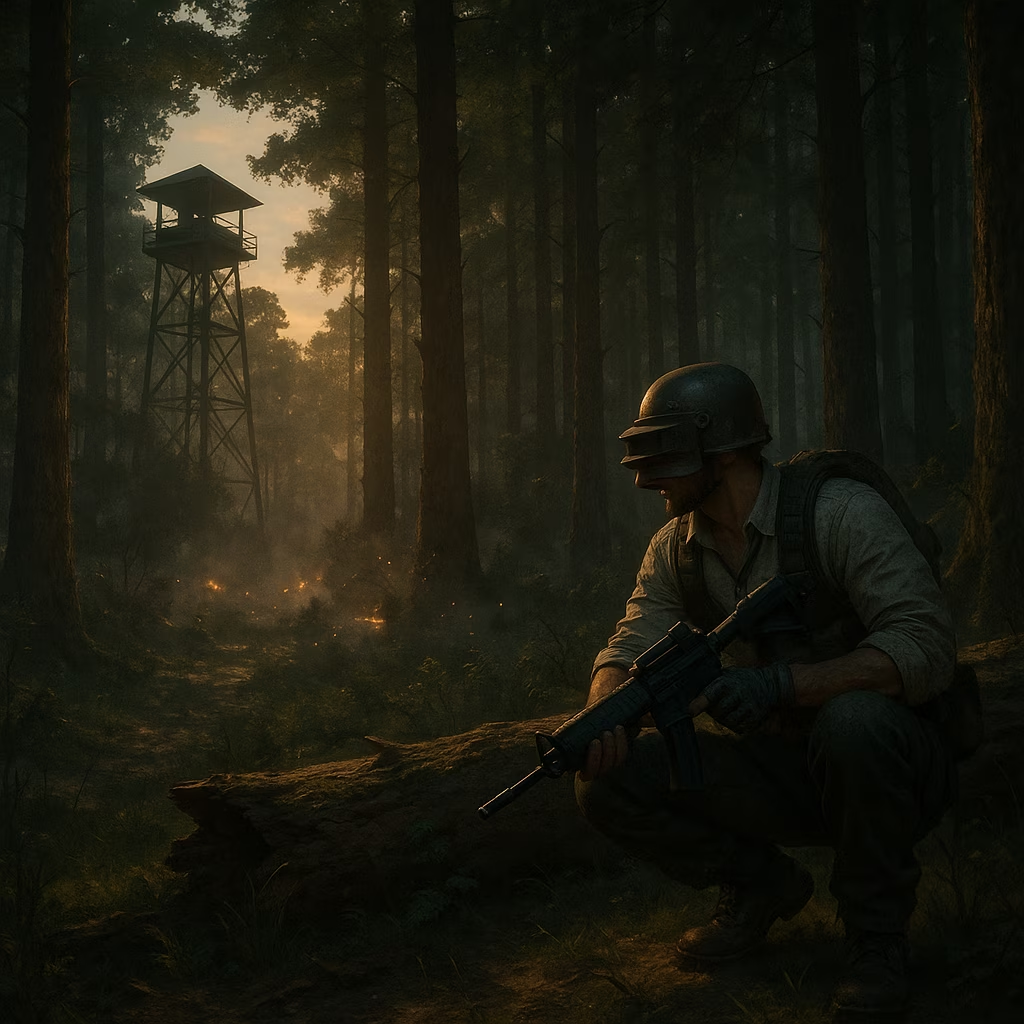
The One-Trick Pony Problem 🐴💥
Krafton had the golden goose—PUBG: Battlegrounds—and it was insanely successful. It bankrolled their IPO in 2021 and made them a global powerhouse. But here’s the kicker: they tried to build a whole cinematic universe around a battle royale game where dudes in level-3 helmets spam grenades. With all due respect to my beloved Erangel, PUBG isn’t exactly Middle-earth. Yet, Krafton dreamed big: The Callisto Protocol actually started life as a PUBG spinoff (yep, the sci-fi horror Dead Space wannabe was supposed to be a survival game in the PUBG universe). That’s like trying to turn Mario Kart into a psychological thriller. Sure, it ultimately became its own thing, but the expectations were still sky-high.
Then reality hit. The Callisto Protocol launched and, while not a disaster, it sold a “mere” 2 million copies instead of the projected 5 million. For a company used to selling 75 million copies of PUBG, that’s a harsh wake-up call. Their other 2022 title, Moonbreaker (a tactical miniature game by Subnautica devs), barely registered. Krafton’s pipeline was barren. They were dangerously dependent on a single IP, and that IP was aging. The suits knew they had to pivot, and fast.
The 2023 Plan: “More Games, New Strategies!” 📈🎯
In that now-legendary internal livestream, Kim laid out the three pillars for 2023: sustainable growth, global publishing expansion, and—most crucially—“nurturing a robust and compelling pipeline of new games.” Translation: stop putting all your chicken dinners in one basket. The company publicly acknowledged that they needed to work with second-party studios, invest in external developers, and restructure internally to pump out games faster. Looking back, it was the corporate equivalent of hitting the reset button.
But there was a catch. Even as they tried to diversify, Kim was hyping up Web3 and deep learning. I remember groaning. “No, not the blockchain again...” PUBG creator Brendan Greene had been flirting with blockchain for his next project, and Krafton saw an opportunity to become a tech-first game company. They argued it was tied to their core competency of game production. Sounded like a huge red flag to me, but hey, I’m just a keyboard warrior with a love for frags.
Fast Forward to 2026: How Did It All Pan Out? 🕹️⏳
Three years later, I gotta give them credit. Krafton actually followed through—and they didn’t go full crypto-bro. First, let’s talk games. The pipeline they promised is now gushing. In 2024 we got The Bird That Drinks Tears, that crazy-looking adaptation of a Korean fantasy novel. It had a budget that could fund a small country and somehow lived up to the visual spectacle. Then came Project Black Budget (a survival horror that actually felt fresh) and Guardians of the Dungeon, a cooperative roguelike that’s now a Twitch favorite. They didn’t abandon PUBG either—PUBG: Evolution dropped in 2025 as a next-gen overhaul with new maps and a proper PvE mode, breathing new life into the franchise. And the second-party publishing arm? They snapped up indie gems like Starbound 2 and Blade of the Lich King (a Dark Souls-like made by a tiny Czech studio), giving them the spotlight they deserved.
Here’s a quick snapshot comparing Krafton’s lineup in the bleak 2022 days versus now in 2026:
| Year | Flagship Titles (Published) | New IPs / Major Expansions |
|---|---|---|
| 2022 | PUBG: Battlegrounds, The Callisto Protocol, Moonbreaker | 1 new IP (The Callisto Protocol, underperformed) |
| 2026 | PUBG: Evolution, The Bird That Drinks Tears, Guardians of the Dungeon, Project Black Budget, Starbound 2, Blade of the Lich King | 5+ new IPs, multiple second-party hits |
I don’t know about you, but that looks like a company that learned its lesson. It’s no longer a one-game wonder; it’s a legitimate publisher with a diverse portfolio.
But What About That Web3 Nonsense? 🤔⛓️
Alright, let’s address the elephant in the room. Krafton did invest in Web3. But instead of turning every game into a pay-to-earn nightmare, they used the tech in ways that mostly stay under the hood. PUBG: Evolution introduced a purely cosmetic NFT skin marketplace that actually works without ruining the economy (shocker). More importantly, the deep learning tools they built—like AI-assisted level design and real-time localization—have genuinely sped up their production cycle. I was a skeptic, and I still side-eye anything blockchain, but it hasn’t turned into the dystopia I feared. Yet.
What Can We Learn from Krafton’s Comeback? 🤓🎓
Krafton’s journey from 2023 to 2026 is a masterclass in course correction. They recognized that even a titan like PUBG can’t carry a company forever. By diversifying, empowering external talent, and actually funding risky projects (instead of just milking existing cash cows), they’ve become a publisher I genuinely look forward to watching each year. Sure, they made some weird bets—did you know they almost greenlit a battle royale set in the Callisto Protocol universe?—but the overall strategy worked.
So if you’re a PUBG vet who got bored and wandered off, now’s the time to peek back at Krafton’s library. They’ve got something for almost everyone, and the scary part? Their 2027 lineup leaked at E3 last month, and it already has a new subnautical survival game from the Subnautica team and a mysterious RPG that might just be the next Elden Ring competitor. I’m here for it.
Krafton finally realized you can’t win a gaming war with just one gun. And as a gamer, that’s the best news I’ve heard in years.
Comments