
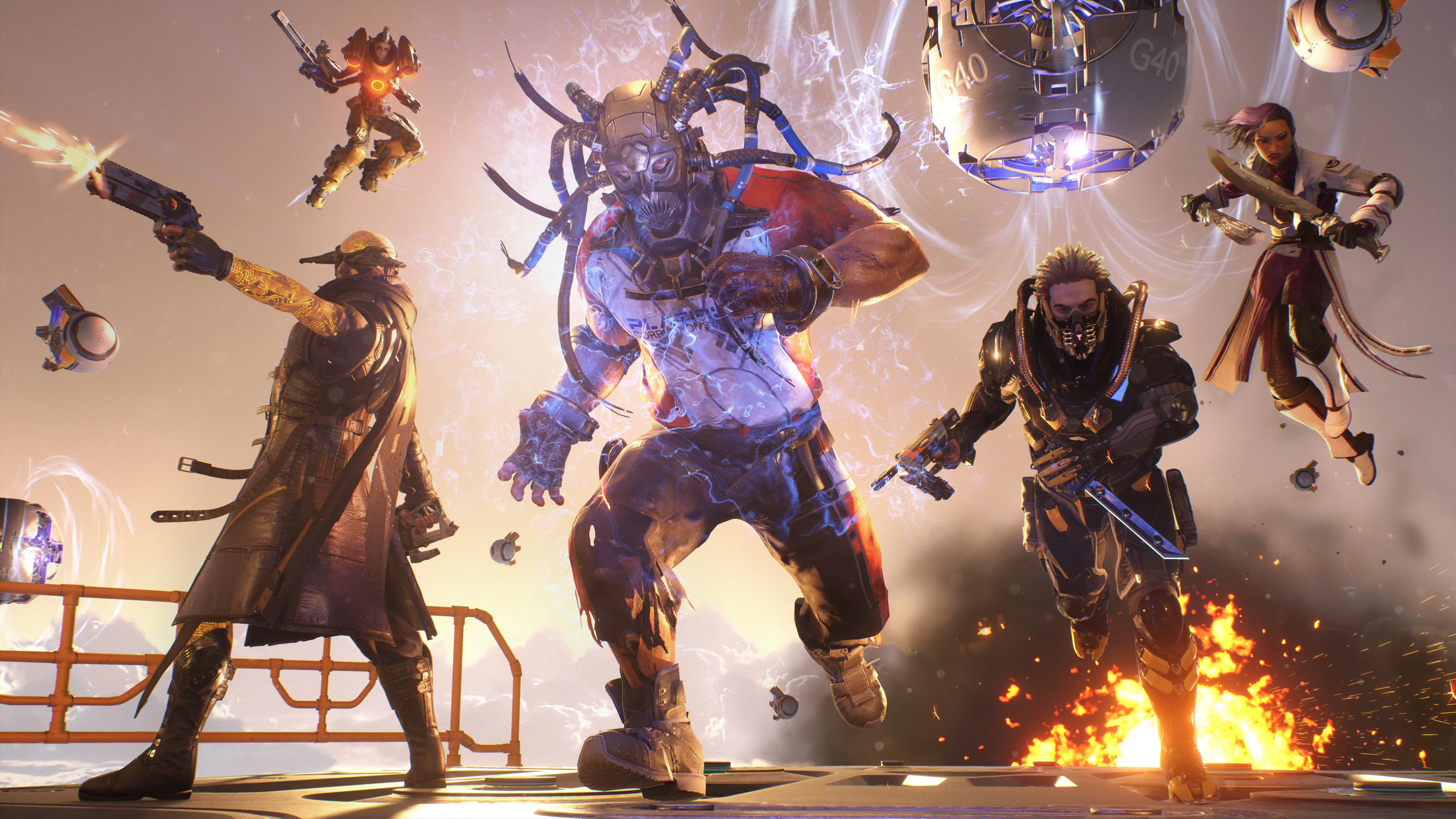
Back in late summer of 2017, after what felt like an eternity in the development oven, Boss Key Productions finally unleashed LawBreakers upon the PS4 and PC masses. The game, brainchild of the legendary Cliff Bleszinski, arrived with a splash of positive critical reception and some genuinely unique gravity-defying, role-based shooter ideas. Critics praised its frenetic pace and skill ceiling. Yet, despite the hype and pedigree, the game's commercial performance was about as impactful as a wet noodle in a zero-gravity fight. Fast forward to the corporate earnings calls, and publisher Nexon was left scratching its head, officially declaring the title's sales had fallen "below our expectations." Ouch. Talk about a reality check that hits harder than a Wraith's melee attack.
So, what went wrong? How did a game with such promise end up being one of 2017's most notable underperformers? According to Nexon's own brass, the culprit wasn't necessarily the game's quality, but rather a case of spectacularly bad, "you've got to be kidding me" timing. The culprit's name? PlayerUnknown's Battlegrounds, or as the cool kids call it, PUBG. While Nexon's overall revenue was doing the cha-cha slide upwards with a 36% year-over-year increase, their North American earnings took a notable dip, and they pointed the finger squarely at LawBreakers' inability to capture an audience. CFO Shiro Uemura didn't mince words, stating, "the timing of its launch turned out to be unfortunate." That, folks, is the corporate equivalent of saying you showed up to a black-tie party wearing swim trunks because someone told you it was a pool party.
The numbers tell the brutal story. PUBG debuted earlier in 2017 and proceeded to go absolutely viral, amassing over 30 million players across PC and Xbox One by that fall. It created a cultural phenomenon—the Battle Royale whirlwind. Uemura elaborated that PUBG's insane popularity was "making the market environment very tough for first-person shooters in general." Imagine trying to sell your fancy new artisanal lemonade stand on the same street where someone is giving away free, ice-cold, brand-name soda. That was LawBreakers' reality. The entire shooter discourse, the Twitch streams, the YouTube highlights—everything was dominated by the "Winner Winner Chicken Dinner" mantra. LawBreakers, with its tight, objective-based arena combat, was a fundamentally different beast, but it was trying to drink from the same crowded water hose.
Let's break down the core mismatch, because it's a classic tale of David (a polished, innovative arena shooter) vs. Goliath (a janky, emergent phenomenon).
| Feature | LawBreakers | PUBG (2017) |
|---|---|---|
| Core Loop | Fast-paced, round-based objective/team deathmatch | Slow-burn, last-man-standing survival |
| Match Size | Small teams (5v5) | Massive (100 players) |
| Pacing | Constant, high-intensity action | Long periods of tension punctuated by chaos |
| Hook | Masterful movement & class abilities | Loot, survival, & the elusive chicken dinner |
| "Vibe" | A competitive sport | A chaotic, unpredictable story generator |
LawBreakers asked players to "git gud" with complex movement like low-gravity jumps and jetpack dashes, mastering specific roles like the healing "Battle Medic" or the teleporting "Wraith." PUBG asked players to find a pan and hide in a bathroom. The market, in its infinite wisdom, overwhelmingly chose the pan. It's a harsh lesson in audience capture. When a genre-defining zeitgeist hits, it doesn't just compete with similar games; it sucks the oxygen out of the room for anything adjacent. Gamers' time, money, and attention are finite resources. In 2017, PUBG was the black hole at the center of the shooter galaxy.
Looking back from our vantage point in 2026, the LawBreakers saga is a fascinating "what if?" case study in the gaming industry. What if it had launched a year earlier, before the Battle Royale tsunami? What if it had adopted a free-to-play model from the get-go instead of a premium price tag? The game itself wasn't "dead on arrival"—it had solid mechanics and a passionate, if small, community. But breaking into the mainstream requires more than just a good game; it requires momentum, cultural traction, and, as Nexon painfully learned, sheer dumb luck with timing. Trying to launch a new IP shooter into the teeth of the PUBG hurricane was, in hindsight, a mission impossible.
The legacy of LawBreakers is bittersweet. It serves as a monument to ambitious design and a cautionary tale about market dynamics. It proved that even with a dream team and innovative ideas, you can still get utterly bodied by the right-place-wrong-time paradox. Boss Key Productions would eventually close its doors, and LawBreakers servers sadly went dark. Meanwhile, the Battle Royale genre PUBG championed evolved, splintered, and remains dominant, with successors refining the formula. The whole episode is a reminder that in the fast-paced world of video games, being a great game sometimes just isn't enough. You need the winds of fate at your back, not a blue zone of death closing in around you.
So here's a virtual toast to LawBreakers—the brilliant, gravity-warping shooter that dared to be different right when the world decided it only wanted one thing. Your timing was off the chain, just in the worst possible way. Rest in peace, you magnificent, misunderstood zero-g frag fest. 😔🎮⚰️
Comments