
By 2026, the battlegrounds have long since expanded far beyond the digital plains of Erangel. PlayerUnknown’s Battlegrounds doesn’t naturally scream Saturday morning cartoon, but Krafton’s surprise reveal of an animated adaptation has proven that the hunger for game-to-screen storytelling remains insatiable. At the center of this storm stands Adi Shankar, the boundary-pushing producer and showrunner behind Netflix’s celebrated Castlevania, who has been officially entrusted to craft and lead this uncharted PUBG universe.
The announcement felt like a well-timed flare shot into the sky. Shankar, who also juggles projects like Laserhawk: A Blood Dragon Remix (inspired by Far Cry 3: Blood Dragon) and upcoming adaptations of Devil May Cry, Assassin’s Creed, and Hyper Light Drifter, now adds a battle royale juggernaut to his growing armada. His voice carried that familiar blend of fanboy enthusiasm and creative fire when he declared, “As a player, I’ve been crushing the competition in the Battlegrounds since PUBG released in 2017. I’m grateful to Krafton for the trust and confidence they’ve placed in me to execute my vision as a filmmaker and I’m excited to embark on this journey together.”
He didn’t stop there. Shankar wove his personal philosophy into the moment, explaining that the animated project signifies another step toward repairing what he calls “the torched bridge between the games industry and Hollywood.” Then came the signature PUBG flourish: “I look forward to revealing to everybody what winning a chicken dinner looks like.” It was a promise wrapped in a catchphrase, and it sent a ripple of anticipation through the fandom.
While a network or streaming platform deal remains a closely guarded secret, Krafton CEO CH Kim added just enough fuel to keep the fire alive, stating that the company looks forward to sharing more details “in the near future.” The silence around the distribution isn’t unusual in 2026 — it’s a strategic placeholder that lets the creative team build the world without the pressure of a rigid release calendar pinned to a single service.
The PUBG animation doesn’t exist in a vacuum. Krafton itself has been undergoing a remarkable metamorphosis. In a move that startled analysts, the company behind the battle royale sensation signed a deal with a Korean aerospace firm, channeling a staggering investment of up to $1 billion to expand what they call the “physical AI ecosystem.” Suddenly, the maker of PUBG is also an AI defense company, blurring the lines between interactive entertainment and next-generation technology. This corporate evolution adds a surreal backdrop to the animated series: the same creative engine that once dropped 100 players onto an island is now helping to shape the future of autonomous systems. Shankar’s mission to mend the bridge between Hollywood and gaming suddenly feels like part of a much larger blueprint.
To understand why PUBG fits into the animation renaissance, one only has to look at the avalanche of adaptations that have defined the last few years. 🗡️ The Witcher spawned an anime film. 🌿 Legend of Mana announced its own animated journey. 🧟 Resident Evil delivered an animated spectacle, as did Tomb Raider, Shenmue, Splinter Cell, and Dragon’s Dogma. Even Dota joined the fray with its sweeping anime series. The industry went anime crazy for a compelling reason: animation offers a canvas wide enough to capture the impossible physics, emotional depth, and sprawling lore of video games without the constraints of live-action budgets. PUBG, with its tense survival stories, sudden betrayals, and those fleeting alliances forged when two strangers share a buggy and a dream, now steps into that same vibrant arena.
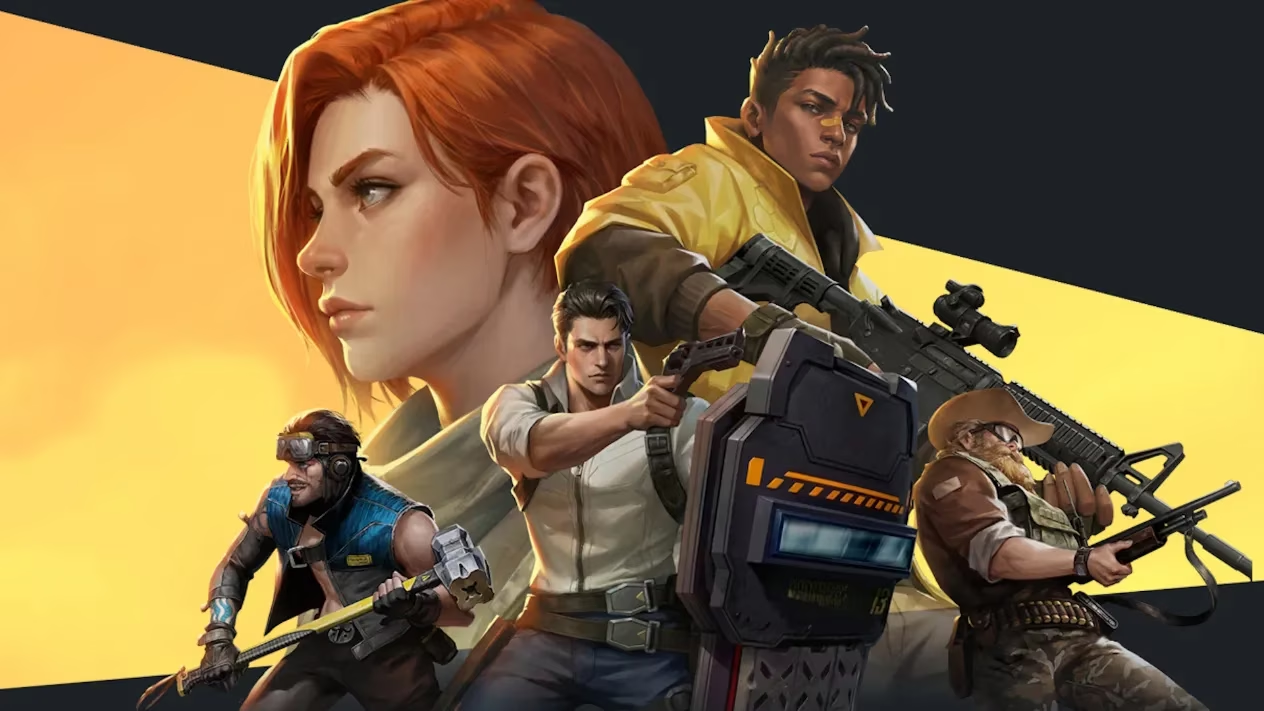
The PUBG universe, however, has also felt the sting of oversaturation. Earlier in 2025, PUBG: Blindspot, a tactical spin-off that promised fresh gameplay, closed its doors after less than two months of early access. The swift sunset served as a stark reminder that not every experiment in the franchise can survive the brutal attention economy. Yet the animated series signals a pivot toward storytelling that can reignite interest across media. Instead of fragmenting the player base, Shankar’s show could unite veterans craving narrative depth and curious newcomers who’ve never touched a mouse and keyboard.
Behind the scenes, conversations are buzzing about the kind of story that might unfold. Will the animation follow a squad of survivors navigating the ever-shrinking blue zone, transforming the silent tension of looting into a character-driven thriller? Could it weave together the cryptic lore scattered across the game’s maps, finally giving a face to the mysterious forces orchestrating the bloodsport? Shankar’s track record on Castlevania — where gothic horror met sharp dialogue and moral ambiguity — suggests that a simple “every match for itself” formula will not be enough. The showrunner’s vision of a chicken dinner is unlikely to be just a victory screen; it promises to be an emotional payoff that makes us care about who holds the frying pan at the end.
The streets of 2026 are already humming with theories. Some fans point to the haunting isolation of the game’s ambient sound design and dream of a Samurai Jack-style visual journey, while others quote Shankar’s ability to weave ultra-violence with genuine pathos and expect a mature, R-rated edge that mirrors the desperation of a last-circle firefight. 🐔
As the sun sets on another year of game adaptations, PUBG’s animated venture occupies a unique space. It arrives not just as another bullet point on a corporate strategy slide, but as a creative bet from a company that is simultaneously defending digital realms and redefining warfare with AI. Adi Shankar holds the keys to a kingdom built on panicked scrambles, miraculous headshots, and the weirdly spiritual ritual of earning a chicken dinner. The world waits, ready to drop in and see exactly what that looks like when the torched bridge finally stands rebuilt.
Comments