
The battle royale arena of PUBG has been rocked once again by the never-ending debate over high ping advantages. For years, players have argued whether a laggy connection is a curse or a secret weapon, with theories flying back and forth. Now, in 2025, this technical controversy has reached a new level of complexity, fueled by compelling evidence from both sides that has the entire community re-evaluating everything they thought they knew about netcode and fair play. The core of the issue remains deceptively simple: does a poor connection give you an unfair edge, or does it just make you an easy target?
Let's break down the traditional arguments first. 🎯 The long-held belief, often called the "High Ping Advantage" theory, posits that players with significant network lag can spot and shoot enemies before they even appear on the high ping player's screen. From the perspective of the lagging player, they see an enemy, line up a shot, and fire—all while, on the enemy's screen with low ping, they might still be safely behind cover. This creates those infamous moments where you dash behind a wall, only to die a full second later from bullets that seemingly came from nowhere. It feels blatantly unfair, like the game is cheating.
However, a counter-argument video titled "High Ping Advantage: A Hoax?" challenged this narrative with solid technical reasoning. This perspective flips the script entirely. It argues that in the server's eyes—the ultimate authority in an online match—low ping users actually hold the advantage. Why? Because the game's netcode prioritizes who's data packets reach the server first. If a low-ping player and a high-ping player shoot at each other simultaneously, the low-ping player's "I shot him" message arrives at the server milliseconds earlier. The server processes that first, registers the hit, and potentially kills the high-ping player before their own shot is even processed. According to this view, high ping is a pure disadvantage in a straight-up, time-synced duel.
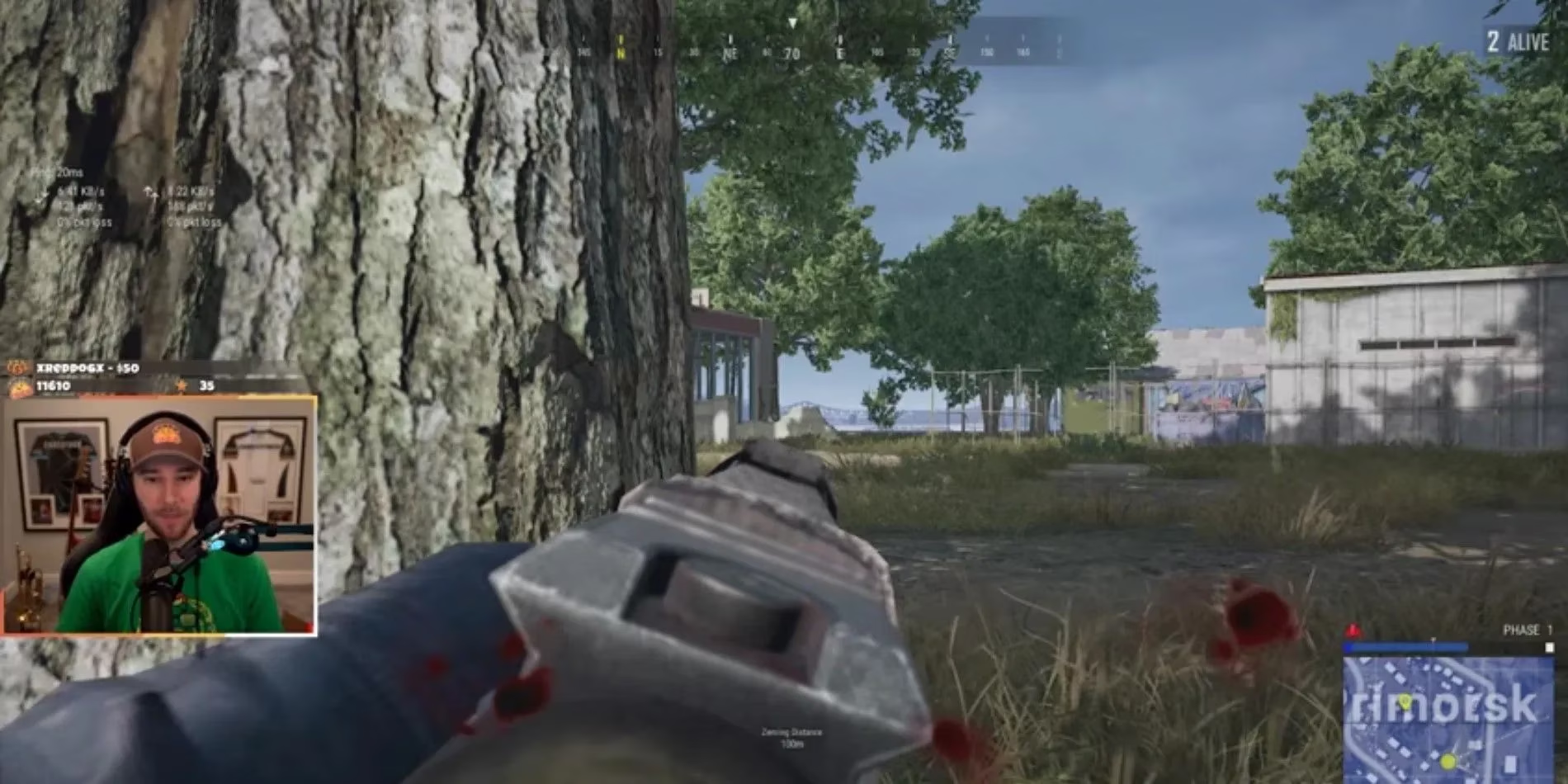
Enter chocoTaco, a renowned streamer and skilled player, who dropped a massive response video that reignited the debate. 😲 His argument wasn't that the low-ping technical explanation was wrong—in fact, he agreed it was theoretically sound in a vacuum. His bombshell claim was that real PUBG combat is never that clean or controlled. Theory meets chaos the moment bullets start flying around trees, rocks, and buildings.
chocoTaco's key demonstration was a masterclass in practical netcode. He showed a scenario where a low-ping player cautiously peeks from behind a tree. A high-ping enemy, due to their lag, sees that peek delayed. But here's the twist: the high-ping player can fire a rapid burst of 5-6 shots during that delayed window. By the time the first shot's damage registers on the low-ping player's client and they react by ducking back, the remaining shots in the burst are still "in the mail," traveling slowly to the server. The server then processes them sequentially, applying damage to the player who is, on their own screen, already safely behind cover. This creates the "dead behind cover" phenomenon, which chocoTaco argues is a definitive, tangible advantage for the high-ping aggressor in peek-and-shoot engagements.
The advantages don't stop there! chocoTaco elaborated on another brutal scenario:
-
The "Frozen Target" Advantage: When a high-ping player swings (or strafes) around a corner, the enemy low-ping player appears on their screen with a slight delay. However, during that delay, the high-ping player gets a precious few frames where the enemy model on their screen is static—not moving, not shooting, not reacting. It's like shooting at a practice dummy.
-
Meanwhile, the low-ping player sees the high-ping player swing out in real-time. They have to track a moving, potentially shooting target. Even though their bullets technically travel to the server faster, they are dealing with a far more dynamic and challenging target acquisition problem.
So, where does this leave us in 2025? 🤔 The community consensus has been profoundly shaken. It's no longer a simple "high ping good" or "low ping good" debate. The evidence points to a situational and asymmetric advantage.
| Ping Type | Advantage Scenario | Disadvantage Scenario |
|---|---|---|
| High Ping | Peeker's advantage in cover fights ("dead behind cover"), seeing momentarily static targets. | Loses straight-up server-priority duels, rubber-banding, general sluggishness. |
| Low Ping | Wins server-priority trades, smooth movement and responsiveness. | Vulnerable to delayed damage bursts, faces unpredictable enemy movement due to lag compensation. |
This complexity is what makes the issue so frustrating for competitive players. PUBG thrives on its high-stakes, one-life-per-match tension. Dying to something that feels outside your control—whether it's because someone's packets were faster or slower—undermines that competitive integrity. chocoTaco's detailed breakdown has convinced a large portion of the player base that the high-ping advantage in specific, common combat situations is very real, swinging the court of public opinion back towards acknowledging lag as a potential combat tool, however unreliable.
Ultimately, the debate highlights the immense challenge developers face in making online shooters feel fair for everyone, regardless of their distance from the server. For now, PUBG soldiers on, a game where your internet connection isn't just a pipeline for data, but a mysterious variable that can sometimes bend the very rules of time and space on the battlegrounds. The only surefire way to win? Maybe get better internet... or move to a region with worse infrastructure and harness the lag? The choice, it seems, is yours. 😉
Comments