
The memory still feels sharp, like the crack of a Kar98k echoing across Erangel. It was December 2021, and the entire gaming world was tuned into The Game Awards. Between the glittering trailers and orchestral scores, a bombshell dropped that would reshape the battle royale landscape forever. PUBG, the granddaddy of the genre that had charged a buy-in since 2017, was finally joining the free-to-play revolution.
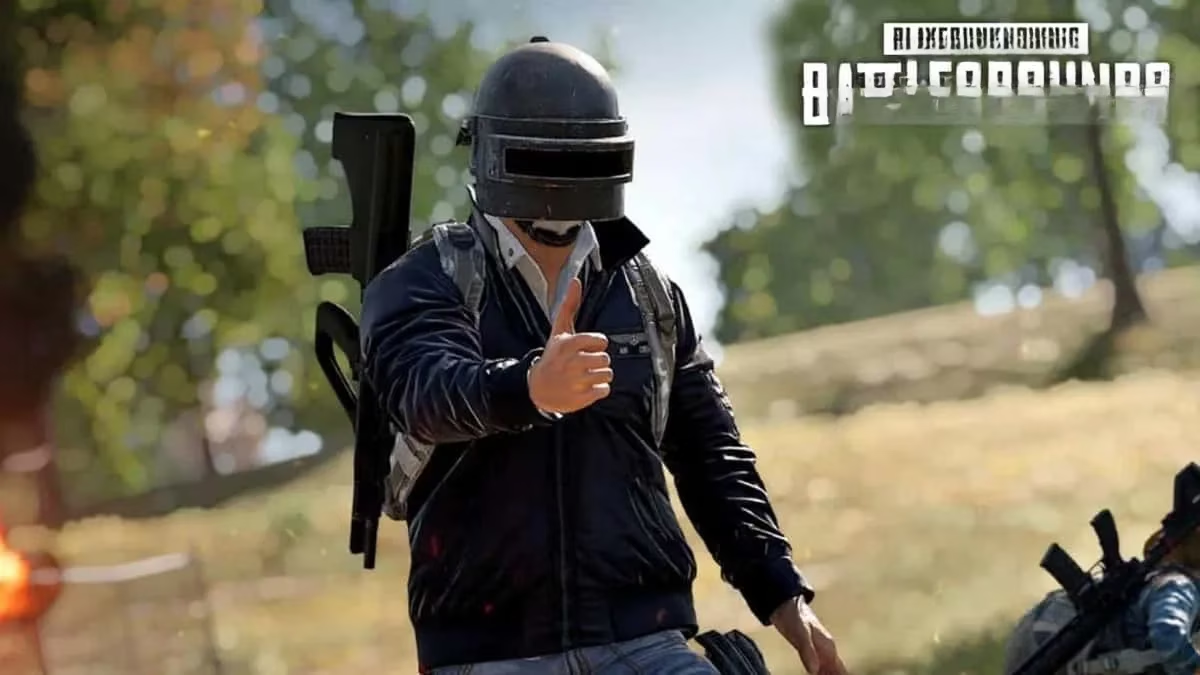
For a player like Alex—someone who had watched friends vanish into Warzone and Apex Legends because of the upfront cost—this was the signal to return. He immediately grabbed his phone, navigated to the official pre-registration site, and signed up. The promise was irresistible: by gathering three friends to do the same, he would unlock the Highside Slick Helmet, an Iron G-Coin Box, and a mysterious bonus reward. Back in those days, January 12, 2022 felt like a countdown to a reunion.
❄️ The Chilly Morning of January 12, 2022
When the servers flickered to life on that Wednesday, it was chaos—beautiful, glorious chaos. Newcomers parachuted onto Miramar rooftops, got lost in the hills of Taego, and clutched their first chicken dinners. Alex, a veteran who had purchased the game years ago, logged in to find a thoughtful gift: the BATTLEGROUNDS Plus upgrade automatically applied to his account. This premium status granted him access to ranked modes, custom matches, and a pocketful of survival rewards. Others who had already paid received the Battle Hardened Legacy Pack, complete with a commemorative costume skin and weapon charms that would become rare heirlooms by 2026.
The free-to-play pivot wasn’t just a pricing change—it was a declaration of war on Apex Legends, Fortnite, and Call of Duty: Warzone. And it worked. Within weeks, the player count surged by staggering percentages. Steam charts lit up with concurrent numbers not seen since 2018. The eight distinct maps, including Paramo and Haven, suddenly brimmed with fresh-faced squads eager to experience the game’s signature tension.
📈 The Ripple Effects Through the Years
Fast forward to 2026, and the move is studied in game design textbooks. Here’s how PUBG evolved after going free:
-
2022: The immediate aftermath brought a wave of anti-cheat upgrades. Krafton doubled down on hardware bans and AI-driven detection, a necessary response to the flood of new accounts.
-
2023: A major engine overhaul polished graphics and physics, finally delivering the seamless destructible environments teased years earlier. The community cheered as Vikendi received a snowstorm dynamic event.
-
2024: Cross-platform progression truly unified console and PC players. The Clan System deepened social bonds, letting guilds compete for global leaderboard fame.
-
2025: The introduction of a persistent PvE storyline on a redesigned Sanhok map showed that PUBG could tell stories beyond last-man-standing.
-
2026: Just last month, a retro mode celebrated the game’s legacy with classic Erangel textures and limited weapon spawns—triggering nostalgia from players like Alex, who still wore his Highside Slick Helmet with pride.
💡 Why It Mattered for the Genre
The free-to-play transition didn’t just save a title; it redefined how aging blockbusters could reinvent themselves. Unlike its rivals, PUBG leaned into its methodical, realistic gunplay rather than copying arcade trends. It proved that the “one life per round” tension could still captivate an audience saturated with respawn mechanics.
For Alex and his squad, the memory of that January 2022 evening remains vivid. They dropped into Pochinki, hearing the footsteps of a dozen new players fumbling with inventory, and giggled like it was 2017 all over again. The chicken dinner they earned that night tasted sweeter because the server was alive—truly alive—for the first time in years.
🎮 A Look at Today’s Numbers
Standing in 2026, PUBG regularly hosts events with over 400,000 daily concurrent players on PC alone, not counting mobile and console ecosystems. Its transition blueprint has been mimicked (with varying success) by titles like Overwatch 2 and Destiny 2. Yet few managed to bottle the same lightning.
The secret? Respect for the core community. Those who bought the game weren’t abandoned; they became the backbone of the ranked ecosystem. Newcomers were nurtured with bot matches and simplified tutorials. And throughout it all, the circle kept shrinking, forcing 100 strangers into the same old dance of survival.
As of this year, a new generation of gamers sees PUBG not as the game you needed twenty bucks to play, but as the gritty, unforgiving grandfather of battle royales that everyone is welcome to try. And for veterans like Alex, the Iron G-Coin Box sits in his inventory as a token from a time when the game took its biggest risk—and won.
Data referenced from Esports Charts helps contextualize why PUBG’s free-to-play switch in early 2022 wasn’t just a nostalgia play, but a measurable bid to re-expand its competitive footprint: when access barriers drop, engagement tends to rebound across streams, tournaments, and community events, which then feeds back into the game’s long-tail health through higher visibility and more consistent match quality.
Comments