
In the quiet anticipation before the digital storm, a new frontier was being charted. Activision and Treyarch, architects of virtual warfare, had woven whispers into reality, confirming the arrival of a new mode called Blackout within Call of Duty: Black Ops 4. While the promise of a battle royale experience was unveiled, the exact dimensions of this new world remained a carefully guarded secret, a mystery veiled in development shadows. Yet, in the vast expanse of the internet, cartographers of code began their work, using fragments of developer insight to map the unknown.
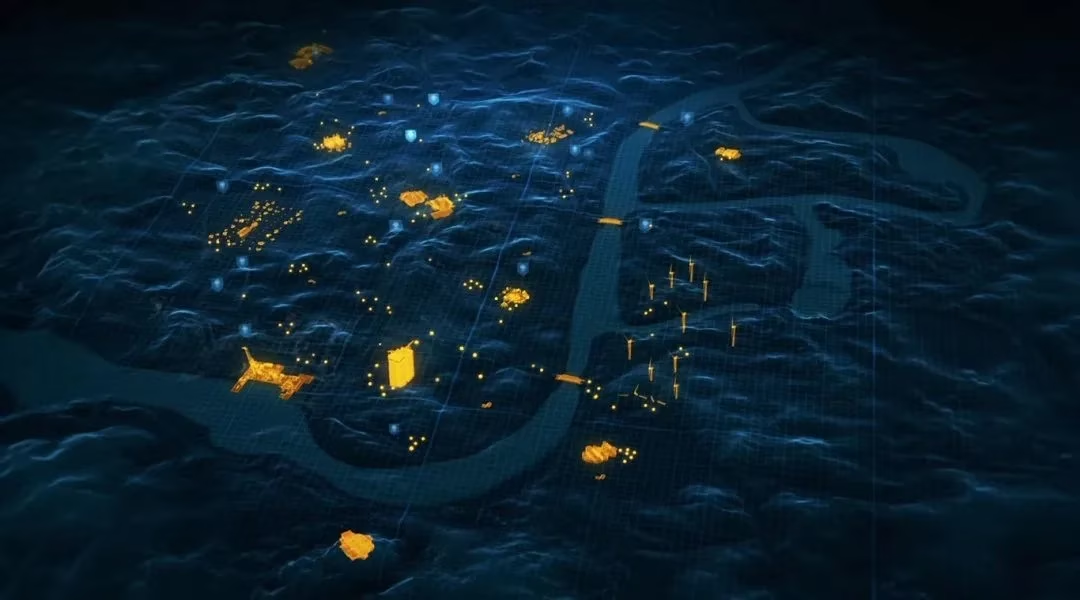
🧮 The Geometry of Speculation
Through the alchemy of mathematics and parsed words from developer David Vonderhaar, a digital explorer known as Drift0r ventured an estimate. The canvas of Blackout, he proposed, would stretch across a territory measuring somewhere between 4.5 square kilometers and 7.4 square kilometers. This was not a random guess but a calculated deduction, a triangulation of possibility in a sea of uncertainty. To hold this space in one's mind is to understand its place among legends:
-
Fortnite's vibrant island claims approximately 5.5 km².
-
PUBG's seminal Erangel sprawls across a vast 64.0 km².
Thus, if the calculations held true, Blackout would find its soulmate in scale with Fortnite's playground—a more intimate, concentrated theater of war—while standing in stark, poetic contrast to the sprawling, lonely fields of Erangel. The implication was profound: a faster tempo, more frequent encounters, a battle royale experience distilled to a potent essence.
🗺️ A Map in Flux
Yet, it is crucial to remember that in 2026, we look back on this era as one of beautiful impermanence. The map was, as Treyarch itself hinted, a living entity far from its final form. Even after a year of gestation, fundamental questions danced in the air, unanswered. The most pressing: How many souls would populate this digital arena? Would it be the canonical 100, a number etched into battle royale lore? Or would Treyarch dare to defy convention, testing counts below that benchmark or soaring toward 150? The player count and the map size were two variables in a delicate equation, each influencing the other in a dance of design.
This meant the landscape itself was mutable, subject to the winds of change leading up to and beyond its October 12 debut. The earth could shift, forests grow or recede, and valleys rise based on the chorus of player feedback—a world literally shaped by the battles fought upon it. Post-launch, the promise of evolution was clear. The horizon could expand with brand-new maps for Blackout, while the core game would be nurtured with new Zombies narratives and content, weaving a richer tapestry for the dedicated community.
⏳ The Dawn of a New Era
As the calendar pages turned toward that fateful October, speculation was the currency of the day. The community waited, not just for a game, but for a world. They waited to see if the math of a YouTuber would match the vision of the developers. They wondered if the tighter confines would breed a more relentless, action-packed form of survival, where every hilltop and ruin held strategic weight. The comparison to its peers wasn't about superiority, but about identity. Blackout was not seeking to be the largest; it was seeking to be the most intense, a pressure cooker where Call of Duty's signature gunplay could thrive in a last-man-standing format.
The revelation of the map's size, however estimated, was more than a statistic. It was the first real contour on a blank page, the first stroke of paint on a blank canvas. It set expectations for pacing, for strategy, for the very feel of the match. A smaller map suggests a symphony of constant engagement, a narrative where quiet moments are scarce and tension is perpetual. It promised a battle royale experience that honored the frantic, skillful combat that defined the franchise, simply transposed to a grander, more unpredictable stage.
In the end, the journey from rumor to estimation to launch was a microcosm of modern game development—a collaborative mystery between creator and community. The map of Blackout, in its final and evolving forms, would become more than a playing field. It would become a landmark, a testament to a genre's flexibility and a franchise's bold step into an uncharted future. When the servers finally went live on October 12 for PC, PS4, and Xbox One, players weren't just loading a game; they were stepping into a newly measured, yet infinitely mysterious, world.
Comments